
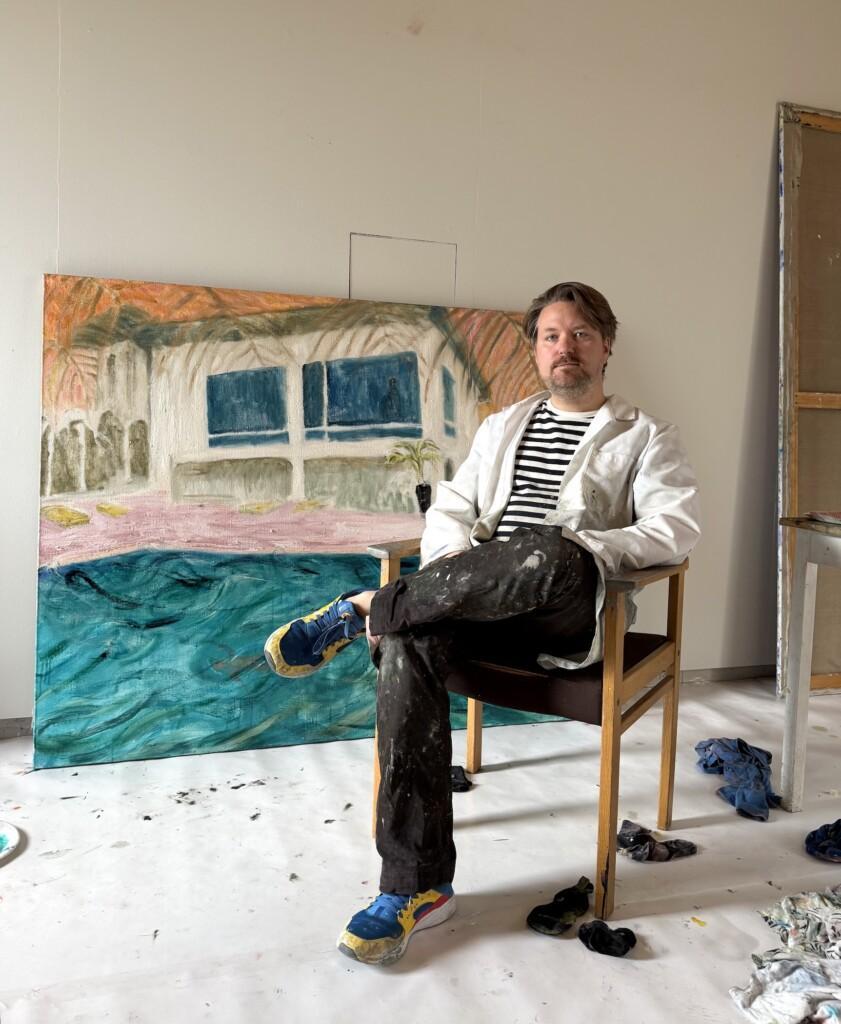
Erik Creutziger in his studio at Villa Snäcksund. Photo: Eveliina Tuulonen / Pro Artibus.
The painter Erik Creutziger’s spring 2026 has been an eventful one. In March, he moved into Villa Snäcksund in Ekenäs as Pro Artibus Foundation’s artist in residence. In mid-May, his solo exhibition opens at Gallery Elverket in Ekenäs and, a week later, another solo show opens at Art Hall Vaasa. Furthermore, Creutziger’s proposal won the art competition organised for the new GRO building.
Creutziger came to Villa Snäcksund from Helsinki, having spent his childhood and youth in Sipoo. He began his art studies at Västra Nylands folkhögskolan in 2002–2003, and then at the Free Art School in 2003–2007. After graduating as a painter, he went on to the Academy of Fine Arts in Helsinki, where he became a Master of Fine Arts in 2013.
Creutziger is known for his fantasy-filled, colouristic paintings, which are predominantly figurative, but also have abstract elements. He has received the Stina Krook Foundation, William Thuring, Grönqvist Foundation and Maire Gullichsen Prizes. His works are, for instance, in the collections of Kiasma, the Saastamoinen Foundation, Helsinki Art Museum, Salo Art Museum, and the Pro Artibus Foundation, as well as in numerous Finnish private collections. Erik Creutziger is a member of the Finnish Painters’ Union, Kuvasto, and Helsinki Artists’ Association.
Pro Artibus curator Juha-Heikki Tihinen interviewed Erik Creutziger in 2025–2026.
When and how did you know you wanted to be a visual artist?
I think I knew quite early on, already in my teens. I’ve always had a vivid imagination and a drive to channel inner worlds through creative expression. A key event that confirmed this path was reading Mika Waltari’s short story An Island of Ice. That literary experience evoked a profound emotional resonance and a sense of artistic freedom that became a catalyst for my own creative delight.
You have studied at Västra Nylands folkhögskolan – VNF, the Free Art School and the Academy of Fine Arts. Is there anything in particular you remember from your time as a student?
The year at VNF was a time of intense development. The school’s stimulating, international environment gave me an opportunity to work in a setting with like-minded people. The community created an important network and a sense of belonging that was very inspiring. Two particularly powerful memories are the study trips to St Petersburg and Haapsalu.
Being admitted to the Free Art School in 2003 was to be a pivotal milestone. The four years there involved a deep dive into the core of painting – it was there that I began to develop my understanding of colour theory, working with values, and the way the light defines the intensity of a colour. I gained a deeper insight into the craft underpinnings and technical conditions for painting. It was a period of intensive artistic maturation.
At the Academy of Fine Arts I particularly appreciated the balance between the high-level facilities and the extensive range of courses, which provided a good foundation for my work. This, combined with the study trip to Russian Karelia with linguists from the University of Helsinki, which resulted in exhibitions at the Kerava and Lappeenranta Art Museums, and the study trip to the Venice Biennale, was very enriching. One personal milestone was the solo exhibition at the Academy of Fine Arts’ gallery on Kasarmikatu Street. It involved extensive work in which I believe my painting achieved a new maturity of expression and confirmed my artistic direction.
Where do you get ideas for your works?
My ideas usually arise on the borderland between lived experiences and imaginary elements. For me, the creative process is about mixing and combining significant memories with sudden, intuitive impulses. I’m fascinated by the meeting between the experienced and the imaginary. Sometimes, places where I lose myself in dreams or a longing for another reality serve as thematic starting points.
Colours and light play a central role in my work. I often start from a specific colour or colour space, from which a story or a motif gradually begins to emerge.
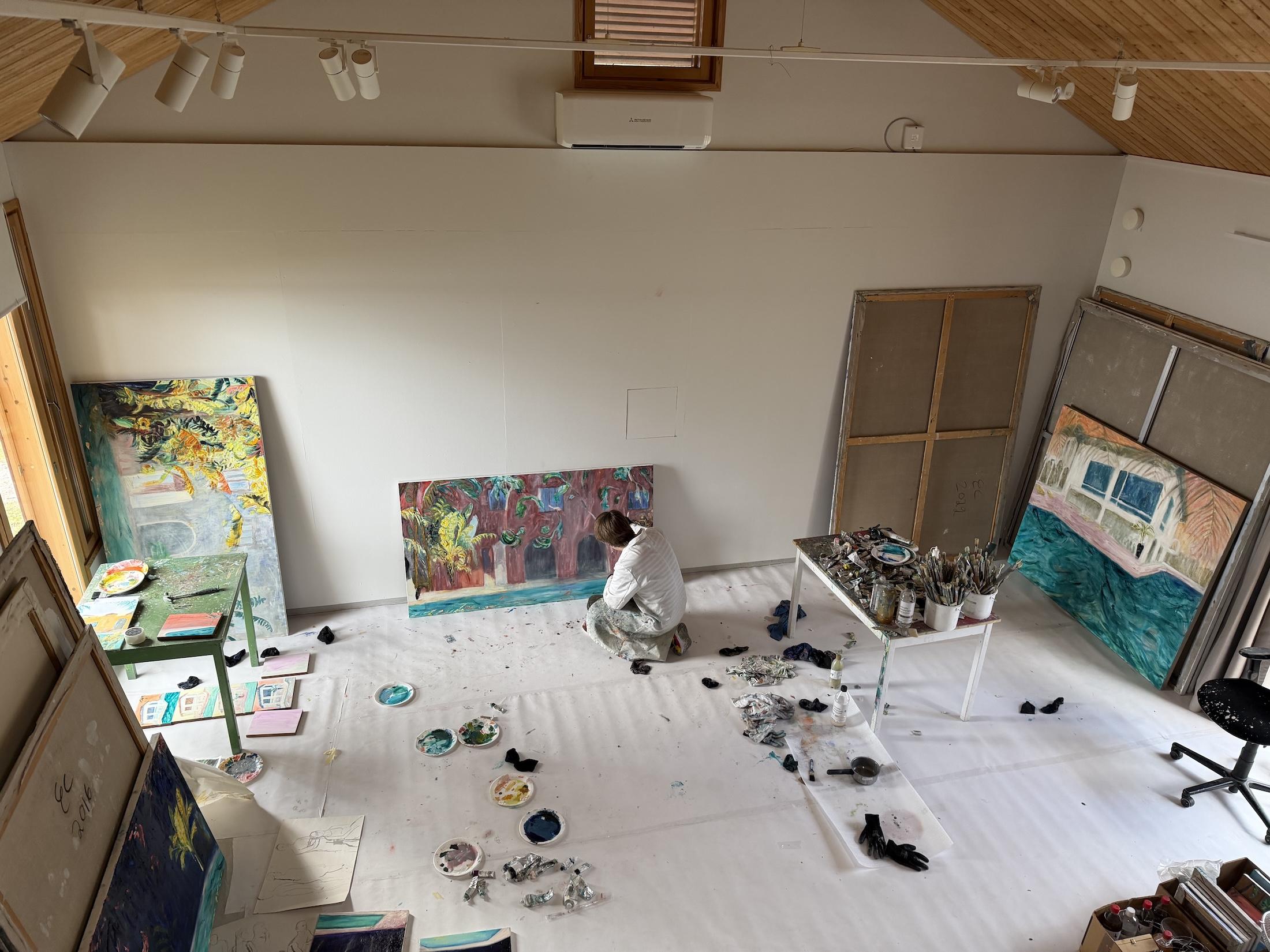
I’m continually inspired by childhood memories, the histories of places, abandoned houses, and the sea.
Which artists are important to you?
There are a lot of artists who are important to me, it’s also something that changes over time. Among others, Leena Luostarinen, Edvard Munch, Peter Doig, David Hockney, Georg Baselitz, Jarl Ingvarsson, Tor Arne, Tal R, Markus Copper, and Anselm Kiefer are all artists who have made a big impression on me.
What is it about painting that fascinates you? Could you think of working in other media?
In painting, my fascination lies in the direct touching and physical contact with the canvas and the material; there is no substitute for that. I am driven by a passionate exploration of colour. I see constantly discovering new colour combinations as a lifelong, almost addictive adventure in my art.
I also have a strong interest in three-dimensional working and sculpture, especially in clay. I can absolutely imagine working with other techniques in the future, for example, with large-scale sculptures outdoors. Previously, I was very interested in photography, where I appreciated the craft work in the darkroom and the magic of the developing process. But then digitalization changed the specific materiality that fascinated me at that time. Although I did consider or dream of a career as an actor, painting won out and became my primary form of expression.
How would you describe your paintings?
My painting mainly occupies the interface between abstract and figurative. I explore the dynamics of how motifs appear or are hidden, and deliberately vary the degree of the observable and the hidden. I try to create evocative atmospheres through well-thought-out colour choices and narrative elements.
You often work serially, can you say what that means to you?
My serial working method is about a desire to go deeper and to experiment with a specific idea or a world that feels captivating to spend time in. The method is also important for creating cohesive wholes, and it’s a red thread running through my exhibitions.
Usually, a theme reaches its natural culmination and I move on to the next. I attach value to a creative environment that is uninterrupted through time. Working in series is a way of continually challenging myself and developing as an artist, of perfecting an idea to the fullest. It fascinates me to observe how the narrative or the atmospheres in the paintings change within the same series, while also exploring different colour combinations and the effect of light over time.
Can you describe your working process?
My working process is something of an endless journey, as I would describe it. It is not divided into clear beginnings and ends, but gets its rhythm from the exhibitions that occur along the way.
A large part of the creative work actually takes place outside the studio. That’s where I gather impressions and let new ideas grow. This involves reading, spending time in nature, travelling, or going to the theatre, films and exhibitions – anything that gives me new stimuli and new perspectives.
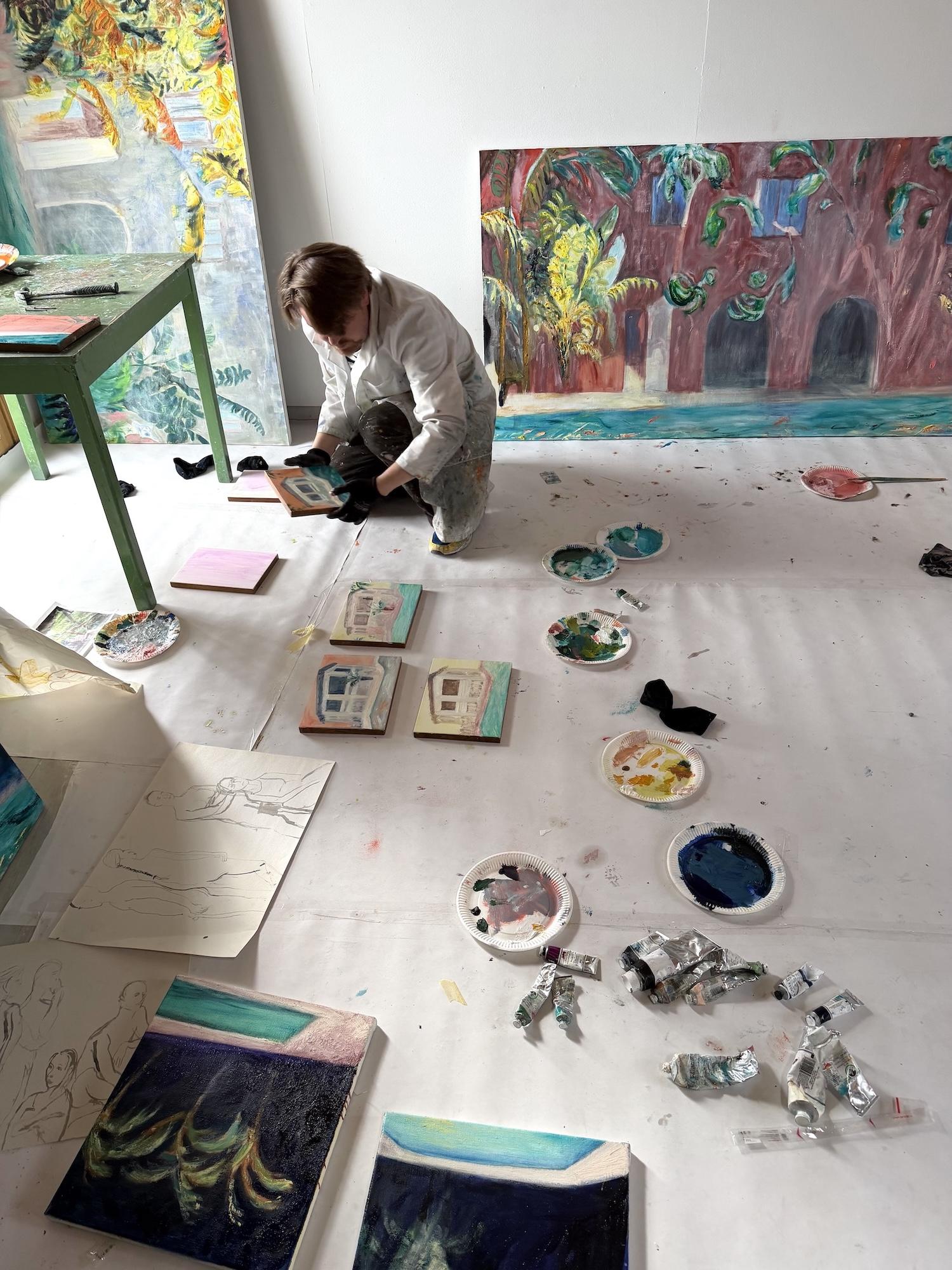
Once I’m in the studio, I elaborate on and develop these impressions. I almost always work on about ten paintings at once. Partly because I paint in multiple layers and it takes time for them to dry, partly to keep up a dynamic flow and to avoid stagnation. This allows me to work quite quickly, even if each individual painting requires a lot of time.
I’m quite intuitive in my painting. Depending on what the theme is at that moment, I sometimes sketch in advance or use reference images as an aid, but often I just start painting directly. I have a bit of a problem with over-detailed planning.
Sometimes there is a waiting period, in anticipation of a specific impulse that can serve as a starting point for a new painting, or an entire series. And yet that wait does not mean a standstill, but is part of my creative cycle.
You have said that your paintings are narrative. What is the narrative in the paintings and how does it differ from narrative in literature, for example?
Yes, I would definitely say that my paintings are narrative, but in a way that is fundamentally different from literature. I like to play with the degrees of the figurative; my works can be both very explicit in their narrative and more suggestive, subtle. This is partly about creating specific atmospheres, partly about the adventure in the act of painting itself, but also about the tensions between the figures and what might have happened in the previous or subsequent moment.
If I compare them with literature, my stories are more like fragments of different realities. They are more sprawling and often repetitions of the same story in different phases and perspectives at the same time.
One big difference is that, while a literary narrative can be very explicit – thoughts, motives, background and cause-and-effect can be described straightforwardly – painterly storytelling is often more open and ambiguous. The viewer has to interpret what has happened, and different interpretations can coexist. In comparison, the words in literature are more irreversible, I think.
My paintings are usually spatial, they show a single moment, or several moments compacted together simultaneously. The story has to be read indirectly through the details, symbols, composition and colours in the image. Paintings condense the story into a visual situation that hints at a bigger story beyond the picture surface. A detail or a gesture can carry narrative weight without anything being said.
Your paintings often have an atmosphere that I personally experience as a mixture of exaltation and melancholy. Do you recognize yourself in that description?
Yes, I definitely recognize myself in that description. I would even say that the dichotomy between exaltation and melancholy is at the very core of my artistic project.
Painting is for me a profoundly existential balancing act. The process is directly linked to my inner psyche; it requires continual openness, honesty and alertness to the shifting phases that I go through. The paradox is that the mere thought of painting fills me with an almost euphoric elation, but it is in the encounter with the canvas that the more complex, melancholic elements come about. Melancholy is not just an emotion, but a key driver and an important source of inspiration. I have always been fascinated by the melancholic worlds of both visual art, literature and music. It is an atmosphere that I think gives my works extra depth.
Transposing these transient inner states into the visual language of painting is a challenge. It is about that elusive, intuitive ability that can’t be taught – it’s either there or it’s not. This is where the magic, or perhaps rather the craft, comes in.
What do you expect from your residency in Snäcksund?
I am very keen to see how the change of surroundings, the peace to work, and having my studio next my home will affect my work. It will also allow me, just for a while, to go and paint when an idea pops up.
What are you working on right now?
At the moment, I am working on my exhibitions at Gallery Elverket and Art Hall Vaasa, both of which open in May.